

Contents
Keir Starmer’s elusive ex-chief of staff Morgan McSweeney finally spoke at length in public — along with a former Foreign Office mandarin. POLITICO whips through what we learned.
LONDON — In Westminster cliché, it was the “Svengali” versus the “Blob.”
British MPs held a marathon hearing Tuesday, raking over Prime Minister Keir Starmer’s ill-fated decision to make Peter Mandelson U.S. ambassador in December 2024 — a scandal now consuming his government.
Starmer sacked the Foreign Office’s top civil servant, Olly Robbins, this month after it emerged he granted Mandelson top security vetting, despite officials raising red flags. Mandelson was sacked in September over the depth of his past friendship with the convicted sex offender Jeffrey Epstein.
Opposition MPs will vote Tuesday night on whether to hold an inquiry into the allegation that Starmer misled parliament by making two claims: that “full due process” was followed in the Mandelson appointment, and that “no pressure whatsoever” was put on Robbins.
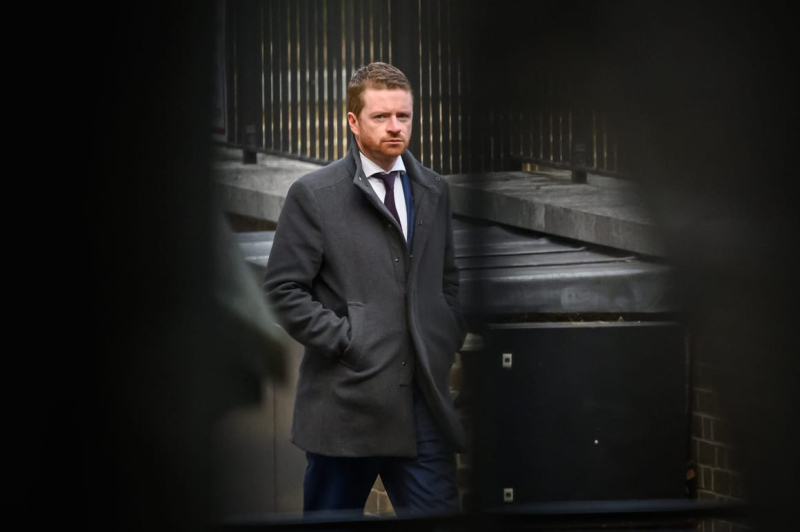
On Tuesday, parliament heard first from Robbins’ buttoned-up predecessor Philip Barton — then Morgan McSweeney, the PM’s political ex-chief of staff who pushed for Mandelson’s posting.
They painted different pictures of life in government, but on some things, the two agreed. Starmer wanted Mandelson in post before Trump’s 2025 inauguration; Downing Street chased incessantly for the result of sped-up vetting; and much of the process was opaque even to the most senior people involved.
The lure of McSweeney in particular — who spoke at length publicly for the first time after gaining a semi-mythical status for his role in Labour’s 2024 election victory — packed out the overheated Foreign Affairs Committee room.
Yet the four and a half hours contained no single bombshell that proved either Starmer misled MPs or that one rogue official — Robbins — could be blamed for everything, despite Starmer’s allies and opponents alike claiming victory.
One senior Labour MP said: “In the end it comes down to [Starmer’s] judgement, which was unforgivable.”
POLITICO whips through what we learned.
1) There are secrets everywhere
Witnesses painted a Whitehall system opaque even to those at the top of it. That includes a security vetting process not fully seen by people making vetting decisions; civil servants withholding information from their bosses; and key decisions taken verbally rather than in writing.
Barton admitted it’s “not unheard of” for senior civil servants to keep information from their political masters. “I am worried that everyone’s going to think that the center of government spends its whole time conniving behind the backs of everyone else,” he observed.
Barriers run deep in the system. Robbins and Ian Collard, the Foreign Office’s security chief, both say neither of them actually saw a vetting form that recommended Mandelson’s clearance should be denied — and which eventually landed on Starmer’s desk. Robbins and Collard were both told verbally that Mandelson’s was a “borderline” case.
That begs a question of whether people making national security vetting decisions have the right facts at their disposal (No. 10 says the process may need reform) — and whether Robbins was sacked for failing to tell the PM something he didn’t fully know himself.
Collard’s evidence also raises questions for the PM, because Collard said that when he eventually did see the vetting form in September, it noted that Mandelson’s was still a “very borderline case.” Starmer had not previously mentioned that.
And Barton’s evidence raises questions for Robbins, too, who No. 10 aides argue should have raised concerns about the vetting with Downing Street. Barton said not a single vetting recommendation was escalated to him during his five years running the Foreign Office — suggesting that the decision Robbins found himself taking was exceptional, not routine.
McSweeney perhaps put it best when he told MPs: “Business in government is conducted with conversations, as well as papers.”
Including for himself. McSweeney had disappearing messages enabled on WhatsApp — including “probably” with Mandelson. That could become an issue when officials’ texts with Mandelson are published in a document dump next month.
2) Did anyone not have doubts?
The remarkable thing about the hearings is that everyone — it now turns out — had doubts about Mandelson all along, even McSweeney.
“Nobody was fine about it. Everyone could see there were risks,” said McSweeney.
McSweeney submitted three questions to Mandelson about his past links and received answers back, which were looked over by Starmer’s then-Director of Communications (and another friend of Mandelson), Matthew Doyle. McSweeney now admits impartial civil servants should have done this job instead.
Early in the hearing, McSweeney told MPs that he “didn’t feel” he had got the whole truth back from Mandelson in those three answers. This would be political dynamite, given Starmer pressed ahead anyway. But later in the hearing, McSweeney corrected himself — saying he acquired these doubts in September, after it emerged Mandelson had been better friends with Epstein than he let on (“it was like a knife through my soul”).
“I didn’t think he had lied [at the time]. I thought he had told the truth, and that was the basis of which I thought we were going ahead,” said McSweeney. “But I also thought if I was wrong, if he had been lying … that might be picked up at [developed vetting].”
In other words, each part of the system was relying on the other to make a judgment call.
Barton, too, said he was “worried” about Mandelson’s Epstein links and expressed reservations to No. 10 National Security Adviser Jonathan Powell, but added: “There was no space or avenue or mechanism for me to put that on the table.”
Barton confirmed Trump’s transition team had voiced concerns too, as previously reported by POLITICO. “Those around Trump felt blindsided by the announcement at short notice, shall we say,” he said.
3) A political appointment to deal with Brexit damage
Mandelson’s appointment happened after Trump won the November 2024 election. If Kamala Harris had won, suggested McSweeney, Mandelson — a wily operator known as the “Prince of Darkness” in Westminster — would not have been appointed.
But Starmer wanted a political appointee from the start. McSweeney confirmed the PM had been considering a political appointment from the beginning of 2024.
Two choices had emerged in the wake of a Trump victory: Mandelson or George Osborne, the former Conservative finance minister, whose candidacy was taken seriously enough that he had due diligence performed on him.
McSweeney said he pushed for Mandelson because he felt Britain was “very, very exposed after Brexit.” It needed a U.S. trade deal as a top priority, he argued, and a former EU trade commissioner to negotiate it.
4) Starmer pressed for it to be done quickly
Both men confirmed that the PM wanted Mandelson in post in time for Trump’s inauguration, although it did not happen in the end. “We didn’t get the timetable we wanted but we wanted it to be done quickly,” said McSweeney.
Barton, Robbins and his allies all argue that this short timescale created intense pressure. The crucial question is exactly what type of pressure, given Starmer previously told parliament there was “no pressure whatsoever.”
Starmer is trying to argue there were two types of pressure — first, to get the job done, which did apply; second, to push through security clearance without proper checks, which he says did not. “I was not aware of any pressure on the substance of the DV [developed vetting] case,” Barton said. But “was there pressure? Absolutely.”
Each side will seize on this as proving their point in the row over whether Starmer misled MPs.
But all now agree that the appointment was done as fast as possible. Barton said No. 10 was “uninterested” in vetting and he only found out the ambassador would be a political appointment on Dec. 15, five days before Mandelson was announced.
Barton also revived a bombshell claim that Robbins raised last week — that some in the Cabinet Office originally thought Mandelson did not need vetting at all, because he was already in the House of Lords. “I thought that was odd and insufficient,” said Barton, adding that everyone agreed on the need for vetting a few days later. “I can’t promise you who said what first. I know what I was told. I was told the Cabinet Office suggested he didn’t require DV.”
(McSweeney insisted he wouldn’t have considered installing Mandelson without full vetting. “I would’ve found that bizarre.”)
McSweeney said No. 10 would chase departments daily, but this was part of normal business, and insisted he was not the only person pushing for Mandelson. He and Barton also flatly denied claims that he swore at the top civil servant over the timeline.
5) More questions about ‘due process’
A key question being posed by the Conservatives is whether the vetting should have been done in full before Mandelson’s job was announced.
No. 10 published a letter on Monday from former Cabinet Secretary Chris Wormald which said it was acceptable to vet an outside appointee after their announcement. The same process applied to McSweeney himself. Downing Street argues that this kills the “process” argument stone dead.
But Barton pushed back against this, telling MPs: “The normal order is vetting and then announcement.” (Though he later said there was a “proper process” in the Foreign Office).
Conservative officials are insisting they have a “slam dunk” case, too, and are also focusing on the final decision to appoint Mandelson. McSweeney revealed four people were in the room — himself, Starmer, Powell and Nin Pandit, a senior civil servant. But there is no record of the meeting, which the Tories argue is poor process.
6) Mandelson was a champion self-promoter
Perhaps the most intriguing line was when McSweeney confirmed Mandelson — then in post as U.S. ambassador — sat in No. 10 on the day of Starmer’s September 2025 government reshuffle.
The envoy was texting McSweeney suggestions for who should get which job, from a different room, despite not being involved in the reshuffle (or so McSweeney insisted).
“He texted me his thoughts … and I have to say on a reshuffle day I get texted a lot of thoughts from a lot of people,” said McSweeney. “The PM did not seek his advice.”
He painted a picture of a man “lobbying for a job” with the government at the same time as applying to be the chancellor of Oxford University. “I think the first person who put Mandelson’s name forward was Mandelson,” said McSweeney.
And McSweeney tried his best to cut public ties with the man he had been associated with for so long. He insisted his first conversation with Mandelson was in 2017 and he only started asking him for regular advice in 2021. They had occasional lunches and dinners, including two in Mandelson’s home.
“He was a confidant for me,” but “I didn’t regard him as my mentor,” said McSweeney. “This was not some hero I was trying to get a job for.”
7) Jobs for the boys?
McSweeney began his statement with a tribute to the women and girls who were Epstein’s victims, often overlooked in the political wrangling. Yet one of the most difficult moments was when he was questioned over an alleged “jobs for the boys” culture in No. 10.
McSweeney accepted there had been conversations about exploring a diplomatic job for Matthew Doyle, Starmer’s director of communications, who was about to leave Downing Street in a shake-up of the comms team. This included the No. 10 private office calling Robbins — then head of the diplomatic service — to scout out any upcoming roles in embassies abroad. (Doyle has said he was unaware of this.)
“The PM wanted me to convey to him that if he wanted to stay in government he should consider doing so,” said McSweeney.
McSweeney insisted Doyle “would’ve had to apply for any of those posts in the same way as anybody else.” He added: “It was the opposite of jobs for the boys — he was losing his job.”
But he also accepted it was about a “softer landing” for Doyle. There was a “duty of care,” he said. That will rankle with many female Labour MPs, and hurt for many of the women who have left the No. 10 operation.