
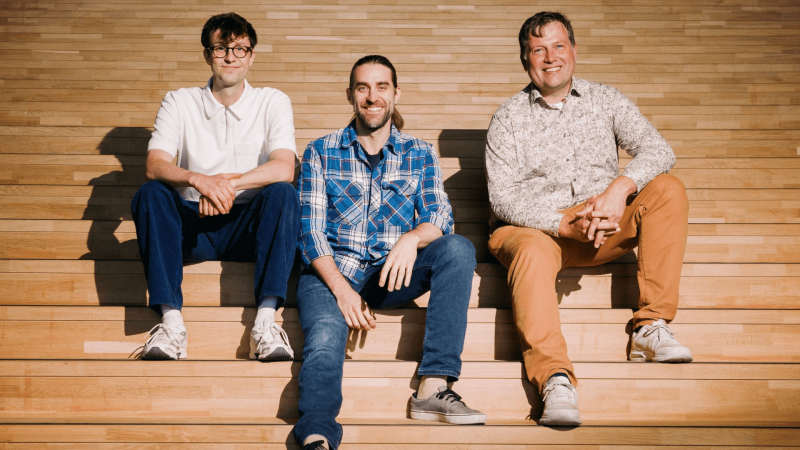

With new funding, simmetry.ai plans to develop a scalable platform for generating synthetic training data, aimed at helping AI developers build computer vision models more efficiently in industries where real-world data is limited.
simmetry.ai, a synthetic data company working across agriculture, food and industrial sectors, has secured €330,000 from NBank, the investment and development bank of the German state of Lower Saxony. The funding was provided through the High-Tech Incubator (HTI) accelerator programme.
simmetry.ai was founded in 2024 as a spin-off from the German Research Centre for Artificial Intelligence (DFKI) by Kai von Szadkowski (CEO), Anton Elmiger (CTO) and Prof. Dr. Stefan Stiene. The company develops a simulation platform that generates photorealistic, fully annotated synthetic data across multiple sensor modalities for training computer vision models. Its current focus includes agriculture, food and industrial computer vision applications.
The platform supports tasks such as semantic segmentation, object detection, 3D pose estimation and regression. It is aimed at computer vision engineers and AI developers working in areas such as robotics, autonomous machinery, quality inspection and other environments that rely on visual perception under complex and changing conditions.
simmetry.ai aims to address what it describes as a key data bottleneck in AI development. According to the company, a significant portion of effort in building AI models is spent on data collection and preparation, particularly in industries where capturing diverse real-world scenarios is costly or difficult. Its synthetic data approach is intended to augment real-world datasets and improve model robustness by generating photorealistic images across controlled conditions, environments and edge cases.
The technology is being applied to use cases including precision weed control, quality inspection in food production, and AI-based monitoring in industrial environments.
Commenting on the company’s focus, Anton Elmiger, said that agriculture was chosen as an initial sector due to its technical complexity and potential impact. He explained that improving crop monitoring and management requires reliable computer vision systems, which are often limited by a lack of diverse training data.
With new funding, the company plans to develop a scalable platform that enables AI developers to generate photorealistic, fully annotated training data tailored to specific use cases, with the aim of reducing the time and cost required to build robust computer vision models in data-constrained environments.