
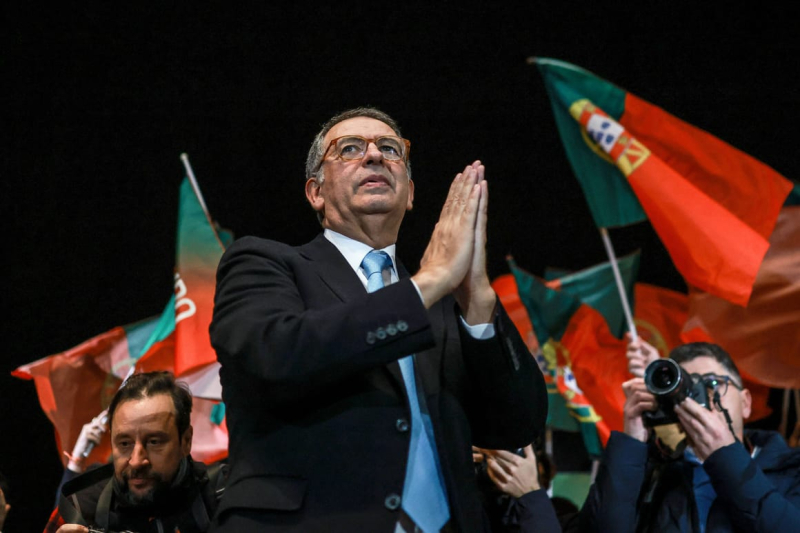

Abstention rates could determine if center-left candidate António José Seguro or far-right leader André Ventura becomes the country’s next head of state.
More than 22 percent of Portugal’s 11 million eligible voters defied extreme weather conditions to cast their ballots in the second round of the country’s presidential election as of noon on Sunday, the National Electoral Commission reported.
Center-left candidate António José Seguro, who won the first round of the election on Jan. 18, is facing off against far-right leader André Ventura in the first runoff in a presidential election in Portugal in four decades. While polls conducted earlier this month suggested the front-runner could pull off an easy victory, the devastating storms that have hit the Iberian Peninsula over the past two weeks have cast doubt on that outcome.
Low turnout could favor Ventura, whose Chega party supporters have proven to be reliable supporters in the last few elections. The ultranationalist group is growing at a remarkable pace and the popularity of its anti-Roma, anti-immigrant and anti-establishment rhetoric has led it to jump from having just one lawmaker in parliament to being the country’s leading opposition party in the span of seven years.
At least 14 people have died during, or in the immediate aftermath of, extratropical cyclones Kristin, Leonardo and Marta, which have caused severe flooding from the southern town of Alcoutim to the bustling northern city of Porto, where the Douro River’s waters overflowed into the Ribeira neighborhood. Fierce winds have knocked out the power supply to more than 100,000 homes across the country, and the Portuguese Institute of the Sea and the Atmosphere has placed all coastal municipalities under yellow alert.
Weather-related interruptions of the country’s public transport networks could complicate voters’ attempts to reach polling stations. Traffic is suspended on Coimbra’s urban railway network and the railway linking Lisbon with seaside suburbs like Estoril and Cascais is operating on a reduced schedule.
To postpone or not to postpone?
Ventura this week called for the runoff to be postponed, insisting the country was “not capable of holding elections in this environment.”
Although 19 especially hard-hit municipalities — home to 31,862 voters — have been given permission to delay the vote by one week, polling stations are open everywhere else. Both outgoing President Marcelo Rebelo de Sousa and the National Electoral Commission insisted postponing the vote nationwide would contravene electoral law.
Center-left candidate Seguro on Friday suggested Ventura was attempting to create confusion over the status of the election because he “has many incentives to push for the electoral demobilization of the Portuguese people.”
In a televised address on Saturday evening, Rebelo de Sousa once again confirmed the vote was moving forward and urged electors to “overcome the calamity” to cast their ballots. Comparing the current conditions to those experienced when presidential elections were last held in 2021 — in the midst of the Covid pandemic — the outgoing president declared “voting means freedom, voting means democracy, voting means Portugal.”
Consequential vote
Portugal is a semi-presidential republic in which the president serves as the country’s head of state and has the power to appoint the prime minister and dissolve parliament.
The president also has the right to veto laws, ratify international treaties, appoint some members of key state and judicial bodies, and issue pardons. Moreover, as supreme commander of the country’s armed forces, the president wields significant influence on Portuguese military deployments.
Although Ventura performed strongly in the first round of voting, his ability to become president has generally been considered unlikely because moderate electors on both sides of the aisle were expected to mobilize to stop him from becoming head of state. The far-right leader has himself hinted that his presidential run is actually meant to gauge support for his eventual candidacy for prime minister.
But António Costa Pinto, a political scientist at the University of Lisbon’s Institute of Social Sciences, said if Ventura pulls off a surprise win, the impact on the country’s political landscape would be enormous.
“In the unlikely scenario that Ventura secured the presidency, there is little doubt that he would use it to do everything to give his party control of the government,” he said, adding that having the far-right leader as head of state would “pose a serious threat to the institutional functioning of Portuguese democracy.”