
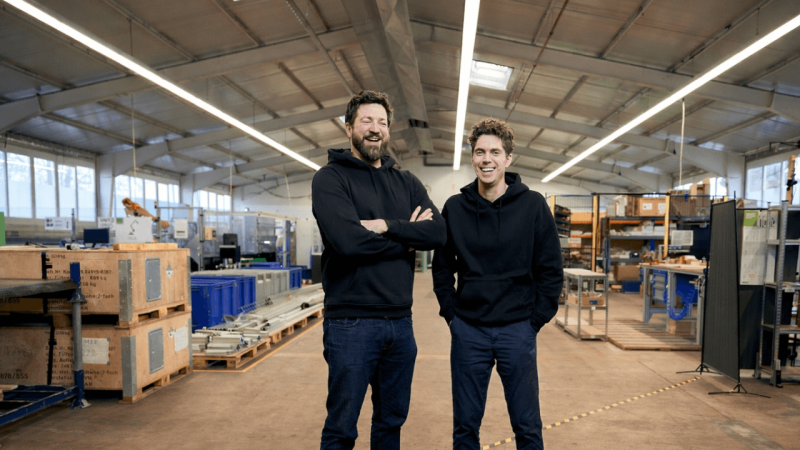

R3 Robotics' long-term ambition is to enable fully automated disassembly across entire vehicle systems.
R3 Robotics (formerly Circu Li-ion) has raised €20 million in combined financing to industrialise the automated disassembly of electric vehicle systems at scale.
The company has raised €14 million in Series A funding, co-led by HG Ventures and Suma Capital, with participation from Oetker Collection, the European Innovation Council Fund (EIC Fund), and existing shareholders including BONVENTURE, FlixFounders, and EIT Urban Mobility, alongside €6 million in European grants.
The funding coincides with the company’s rebranding from Circu Li-ion to R3 Robotics and a clear expansion of scope: from battery disassembly to automated dismantling of complete electric vehicle systems, including e-drives, power electronics, and other high-value components.
The long-term ambition is to enable fully automated disassembly across entire vehicle systems.
Today, manual disassembly remains labour-intensive, costly, and difficult to scale safely. R3 Robotics addresses this challenge with a dismantling platform designed for repeatable, high-throughput operation in continuous industrial environments.
It combines computer vision, AI, and specialised robotic tooling to automate the disassembly of lithium-ion battery packs, e-motors, power electronics, and other high-value electrified components. The system minimises human exposure to high-voltage hazards and delivers the cost structure and reliability required for industrial-scale operations.
European policy reinforces this shift. The Critical Raw Materials Act underscores the need to strengthen secure and resilient domestic supply chains for strategic materials. In parallel, the EU Battery Regulation introduces progressively stricter recycling-efficiency targets, including a 70 per cent target for lithium-based batteries by 2030, alongside material recovery and recycled-content requirements.
Together with the End-of-Life Vehicles Directive, these frameworks are reshaping industrial recycling infrastructure.
“The bottleneck isn’t recycling technology; it’s clean feedstock, meaning getting complex electrified systems safely and cost-effectively dismantled at an industrial scale,” said Antoine Welter, CEO and co-founder of R3 Robotics.
“We’re building a dismantling platform that turns end-of-life systems into a strategic source of critical materials and reusable components for advanced industrial economies.”
The company is working with Fortum Battery Recycling, a major integrated battery recycler active across multiple stages of the European battery recycling value chain, to deploy its automated dismantling technology at industrial scale. It also works directly with automotive OEM customers, processing end-of-life battery systems through its centralized dismantling infrastructure to recover critical raw materials and support secure sourcing.
“R3 Robotics is addressing a critical industrial bottleneck in the supply of strategic raw materials,” said John Glushik at HG Ventures.
“Scalable dismantling infrastructure is essential to strengthen resilience and secure access to critical inputs.”
“R3 Robotics combines strong industrial execution with a scalable approach to dismantling complex electrified systems,” said Natalia Ruiz, Partner at Suma Capital.
“This capability is critical to unlocking materials and components at scale.”
To further strengthen its strategic development, R3 Robotics has added Peter Mohnen, former CEO of KUKA, to its advisory board.