


The Heritage Foundation identified European groups for U.S. backing.
BRUSSELS — The U.S. is reorienting its foreign funding program to export MAGA ideology to Europe — and a growing set of far-right and conservative think tanks and political groups are lining up to take Washington’s money.
U.S. State Department officials have held early talks about government funding with representatives of the new MAGA-supporting French think tank Western Arc and Britain’s Free Speech Union, an advocacy group.
Those approaches were informed by a list provided to U.S. officials by the Washington-based Heritage Foundation of groups the MAGA-aligned think tank described as “like-minded.” Other far-right and conservative groups in Italy and Brussels told POLITICO they would also be interested in support from a U.S. administration they see as an ally.
POLITICO spoke to representatives from 10 European think tanks and policy groups, all of them aligned in some way with far-right politics. They described a burgeoning ecosystem of ideologically-aligned organizations that had rapidly professionalized in recent years and were working to build cooperation with similar groups across the Atlantic.
With U.S. President Donald Trump’s second presidency giving European nationalists and hardline conservatives a champion at the head of the world’s largest economic and military power, groups on both sides of the Atlantic want to seize the moment. Their ambition is to repurpose the soft-power tools America once deployed to spread the gospel of liberalism, to expand their reach and power and ultimately rebuild the West in their image — a project both sides call a “civilizational alliance.”
French connection
Nicolas Conquer, a former media director for Republicans Overseas France, launched Western Arc, a self-described “MAGA-inspired” think tank in Paris in December. Conquer, a French-American citizen, said he had discussed specific projects that could receive funding with several U.S. State Department officials.
Western Arc pledges to connect “ideas, people and projects” across the Atlantic to “organize western civilizational renewal.” Its mission statement aligns closely with language from the U.S. National Security Strategy, released earlier that month, as well as a prior essay from Samuel Samson, a senior adviser for the U.S. State Department.
Conquer said he had been in touch with Samson and others in the U.S. State Department in the past few months and was exploring ideas for projects of mutual interest, such as stakeholder mapping or transatlantic trips for targeted groups, including around the 250th anniversary celebrations of U.S. independence this July.
“There is this logic, which I think is very healthy, of project-based funding,” Conquer said.
The U.S. State Department did not answer a detailed list of questions. But in response to a query about U.S. funding of European organizations, a spokesperson said: “This is a transparent, lawful use of resources to advance U.S. interests and values abroad.”
Samson made headlines last year for proposing the use of American taxpayer funds to support far-right leader Marine Le Pen. He traveled to European capitals last May to meet with NGOs and civil society groups.
U.S. State Department officials approached The Heritage Foundation in the second half of last year to ask which organizations in Europe would be viable targets for funding, said Heritage Foundation Senior Research Fellow Paul McCarthy.
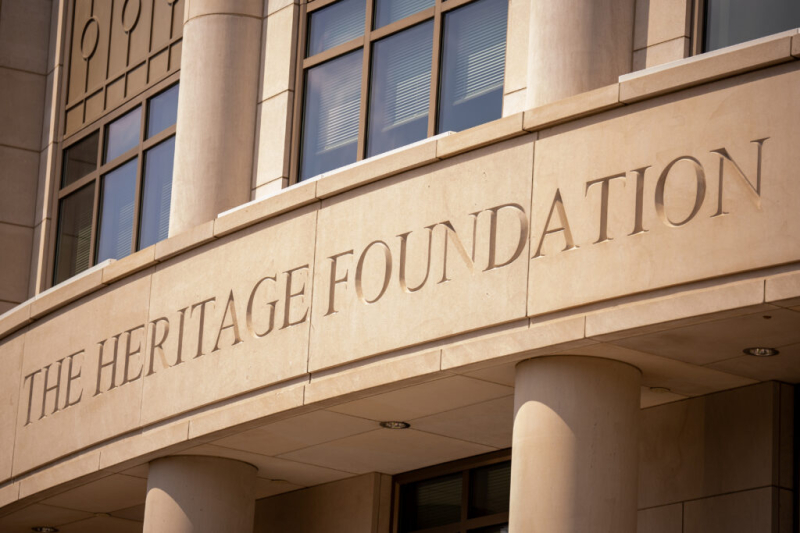
“We’ve suggested some institutions, just a few names of organizations back in the late summer, early fall. And maybe that formed the basis of it,” he said.
The amount of money discussed at that time was “tiny.” That was before the U.S. National Security Strategy laid out a policy of “cultivating resistance” in Europe and boosting organizations that stood against left wing “censorship” and migration policies that it said were “transforming the continent and creating strife.”
“Once they got the imprimatur in the national strategy, it’s really taking off right now,” said McCarthy, while stressing he had no inside knowledge of the State Department’s latest plans.
Last week the FT reported that U.S. Under Secretary of State Sarah Rogers was pushing a funding program for think tanks and institutes, with a focus on London, Brussels, Paris and Berlin. In December she met with Toby Young, a British social commentator and founder of the Free Speech Union.
“We’ve discussed the possibility of the State Department funding some of the FSU’s sister organisations in other parts of the world, but not the organisation I run,” Young said. He would not be drawn on which organizations he meant, but the British Free Speech Union is affiliated with similar bodies in Australia, Canada, South Africa and New Zealand, indicating the U.S. State Department’s plans may not be confined to Europe.
American tradition
U.S. government funding for European institutions is not a new phenomenon: Throughout the postwar era the U.S. has supported projects that promoted democratic ideals and American-style liberalism. Since the 1950s, Radio Free Europe floated the sounds of capitalist freedom into Eastern Europe, all on the U.S. taxpayer dime.
This, along with U.S. philanthropic funding, helped many think tanks and other organizations grounded in mainstream liberal values flourish in Europe. Many became highly-networked policy shops that acted as a pseudo civil service, crafting reports and laws that could be transposed into ministerial proclamations.
The right has taken note of that playbook.
“There was a time when the right were incredibly unprofessional, unconnected, and so concerned with their own national concerns that it’s very difficult for them to see beyond that,” said John O’Brien, head of communications at MCC Brussels, a think tank funded by a private educational institute in Hungary with close ties to the government of Trump ally Viktor Orbán.
That has rapidly changed, O’Brien said. Though unlike many networks of progressive institutions, the right has yet to set up a WhatsApp group for collaboration — “If there is, we’re not part of it,” said O’Brien — right-wing operatives and thinkers meet regularly at major events, like the CPAC and NatCon summit series.
They also invite one another to co-host meetings or attend events as panelists. From the U.S. side, The Heritage Foundation, which authored Trump’s Project 2025 blueprint for government, is a frequent guest of the European right.
On Tuesday, The Heritage Foundation’s McCarthy appeared on a panel in Rome co-hosted with the Fondazione Machiavelli. McCarthy said The Heritage Foundation was fostering ties with groups in Europe through joint summit hosting and research. Their aim is to push back against “European federalism” and the “green transition madness” while fostering a vision for families that excludes gay couples, trans rights and promotes higher birth rates.
Collaboration among such groups is “growing,” said Fondazione Machiavelli President Daniele Scalea. On its website, the center advertises formal partnerships or signed memoranda with a series of other right-wings groups: The Heritage Foundation, the Jerusalem Institute for Strategy and Security, Hungary’s Oeconomus Economic Research Foundation, and the Center for Fundamental Rights, which organizes CPAC.
“But it’s most like a friendship,” he said. “Since we have common missions, we have shared values and shared views of the future … We’re not formally intertwined, we have no institutional bond and link, we are not exchanging money or resources … We are just working together because this is making it more effective for everyone else.”
Scalea added that his institute had a “lot of commonality with the Trump administration.”
So far he hasn’t heard directly from the U.S. government about funding being made available to organizations like his, but he said he would look at any funding proposal. “We will see. But for now, we do not have any concrete opportunity or thing to look at.”
‘European independence’
This year, Trump has poured accelerant on existing tensions between Europe and the U.S. by pressuring Denmark to cede control of Greenland, the world’s largest island. That left many right-wing groups walking a narrow line between standing up for European sovereignty and maintaining their ideological alliance with the White House.
But calls for “European independence” by leaders such as European Commission President Ursula von der Leyen have presented right-wingers with an opportunity to frame themselves as the true defenders of the Western alliance.
“It’s quite important, especially in this moment, to maintain a unity inside the Western world,” said Francesco Giubilei, president of Nazione Futura, another Italian think tank that has partnered with The Heritage Foundation. “It’s not easy. We understand that sometimes the position of Trump is different from the position of Europe. But we think that if in this moment, we create a split between the United States and Europe, we are doing a favor for China, we are doing a favor for Russia.”
Some of the organizations POLITICO contacted said they weren’t interested in funding from a foreign government. But where European laws prevent direct foreign funding of political parties, some are finding other means of collaboration.
Gerald Otten, a lawmaker with the far-right Alternative for Germany (AfD) party, traveled to Washington in January as part of a delegation from the German Bundestag. Prior to his visit he had been invited by the U.S. embassy to discuss possible joint work. AfD officials are planning to travel to the U.S. for an event in March billed as a “counter Davos” by Republican member of Congress Anna Paulina Luna.
Markus Frohnmaier, a leading AfD foreign policy lawmaker and trustee of co-chair Alice Weidel, will meet Rogers on the sidelines of the Munich Security Conference this week.
Scalea, of the Fondazione Machiavelli, said having Trump in the White House gave groups in Europe a sense they were no longer on the fringes.
“We have an ally, a powerful voice,” he said. “It’s not just a conspiracy theory that we are saying mass migration is making us weaker as a nation, but it’s something that is said also by the leader of our alliance. This is obviously useful for us.”