

Contents
- 1 Europe’s critical materials paradox: reliant on imports, rich in waste
- 2 “Yes, it works”: how tozero validated its recycling tech with OEMs
- 3 Turning material science into real-world supply
- 4 From chemistry to geopolitics: why lithium and graphite recovery matters now
- 5 Beyond sustainability: winning on price
- 6 Building the blueprint for Europe’s battery recycling plants
- 7 “Europe must take more risks.”
As demand for lithium and graphite surges, tozero is building a battery recycling playbook for Europe — and aiming to compete with mining on cost.
Europe is racing to secure the critical raw materials needed for its energy transition, yet remains heavily dependent on imports — particularly from China.
At the same time, a growing volume of end-of-life batteries is creating a domestic source of lithium, graphite, and other materials that has, until now, been difficult to recover at scale. Battery recycling startup tozero has launched its first industrial demonstration plant in Germany, marking a step toward turning end-of-life batteries into a domestic supply of critical raw materials at scale.
The plant will deliver recycled lithium and graphite to companies across sectors, including construction, ceramics, and lubricants, with further materials and industries to follow.
Located in Bavaria at Chemical Park Gendorf, the plant can process more than 1.500t of battery waste every year. From this waste, tozero can produce high-purity lithium carbonate – the equivalent of saving 6,000 electric vehicles’ worth of batteries from landfill – and recover graphite and nickel-cobalt mix.
Founded in 2022 by Sarah Fleischer, a serial entrepreneur and mechanical engineer, and Dr Ksenija Milicevic Neumann, a leading metallurgy expert, tozero has scaled at pace.
In April 2024, nine months after opening its pilot facility, it became the first company in Europe to deliver recycled lithium to commercial customers.
I spoke to Sarah Fleischer, Co-founder and CEO of tozero, to learn more about how the company is not only scaling its own operations, but effectively creating a playbook for an emerging industry.
Europe’s critical materials paradox: reliant on imports, rich in waste
Global demand for lithium is set to quadruple by 2030, while in the EU alone, graphite demand is expected to rise by up to 25 times by 2040, driven by EVs, grid-scale storage and industrial electrification.
Yet Europe remains almost entirely reliant on imports – China controls global graphite supplies, and 99 per cent of Europe’s lithium comes from abroad. Ironically, Europe is sitting on a stockpile of the very materials it’s scrambling to source from the growing number of end-of-life batteries, largely due to Europe’s growth in EVs
With demand expected to exceed supply by over 33 per cent from 2035, battery recycling is becoming essential — and tozero is aiming to help bridge the gap.
“Yes, it works”: how tozero validated its recycling tech with OEMs
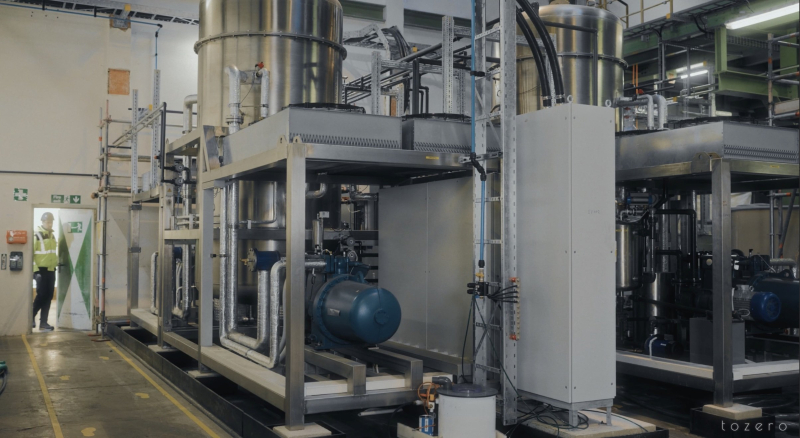
tozero’s approach to battery recycling is fundamentally different from conventional methods. By deploying a proprietary acid-free, hydrometallurgy process, it focuses on low-temperature, water-based chemical processing rather than burning batteries.
Building on this, the company aims to close the battery materials loop and support Europe’s ambition to achieve greater independence in critical raw materials. This aligns with the EU Critical Raw Materials Act, which calls for 25 per cent of supply to come from recycling sources.
tozero’s recycling takes place in a single cycle, and the recovered materials are pure enough to feed directly back into manufacturing. tozero has already demonstrated successful qualification of its recycled lithium and graphite for lithium-ion batteries with leading cathode and anode manufacturers.
Through pilots with OEMs, including BMW, tozero has been able to validate both the flexibility of its recycling process and its ability to meet future regulatory requirements. Fleischer notes that the inbound interest itself was an early signal of market demand:
“First of all, they approached us for the pilots, which I think is already a strong statement about the demand for verifying whether this type of recycling actually works.”
She explains that tozero’s approach differs fundamentally from conventional recycling methods:
“What we’re doing is very novel — it has not been done before.
Conventional battery recycling is based on burning batteries at very high temperatures, around 1,400 degrees. It’s called pyrometallurgy. You can extract nickel and cobalt that way, but lithium and graphite are essentially lost in the process. That’s where we come in.”
Working with multiple OEMs — including partners that remain undisclosed due to NDAs — the pilots were designed to answer two core questions:
“First: is our process agnostic? Can we handle different battery chemistries? Every OEM has a different battery.
Second: can we recover critical materials like lithium, and can we meet regulatory requirements — for example, the 2031 European Battery Directive, which requires over 80 per cent recovery of critical raw materials?”
The results, she says, came earlier than expected:
“That’s what we were able to demonstrate. From a very early stage, we could already show recovery rates that meet those future requirements.”
Ultimately, the pilots confirmed both the technical robustness and regulatory readiness of the process:
“So the key learning is: yes, our process is chemistry-agnostic, and yes, we already comply with future EU recovery regulations — even though they only come into force in 2031.”
Turning material science into real-world supply
Tozero has achieved significant growth by embracing a lean, agile mindset with a team of just over 30.
“In just under four years, tozero has gone from lab-scale experiments to industrial operations, and we’re consistently proving that recycling isn’t just a pilot project – it can be delivered at a level capable of giving Europe a homegrown, circular supply of critical materials its future runs on.”
Fleischer sees the team’s ability to move fast and focus on execution as critical:
“We don’t just talk — we deliver. We shipped our first lithium carbonate to customers in 2024, starting with hundreds of kilos. Now we’re moving to tonnes with the demonstration plant. That early delivery is critical.
This is material science — if you don’t work directly with customers, you can’t improve the product. So our approach is simple: we do it, we learn from customer feedback, and we iterate quickly.”
From chemistry to geopolitics: why lithium and graphite recovery matters now
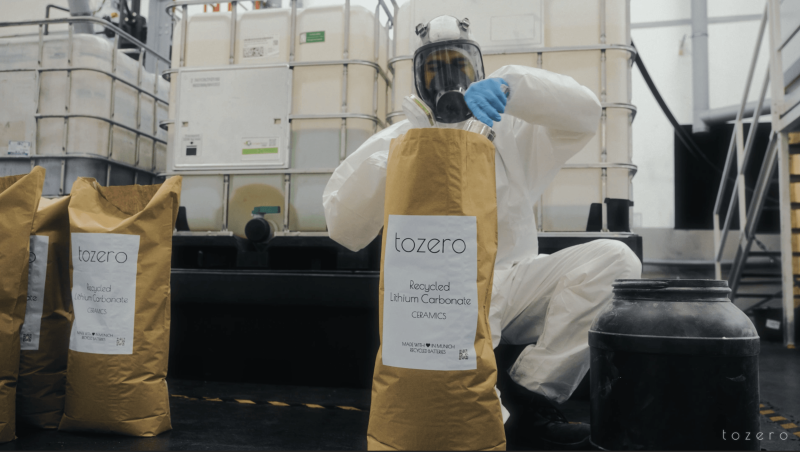
As a deep tech company, tozero has focused heavily on understanding the behaviour of lithium and graphite at a chemical level — what they respond to, and what they don’t — as the foundation of its process.
“That allows us to extract them efficiently.”
Fleischer points in particular to the growing importance of graphite, driven by shifting supply chain dynamics and increasing geopolitical pressure. She argues that while the European Union is still defining what a comprehensive critical raw materials strategy looks like in practice, other regions have long treated this as a strategic priority:
“If you look at the US, they defined this decades ago — already in the 1930s — to secure materials essential for industrial growth.”
Europe, by contrast, remains heavily dependent on imports for materials tied to energy independence — particularly from China. More than 90 per cent of refined lithium is imported, while graphite supply is even more concentrated, with close to 99 per cent sourced from China. This imbalance is already translating into rising demand across industries:
“That’s why we’re seeing a lot of inbound interest from customers. It’s not just the battery industry — you also have glass, ceramics, lubricants, and cement industries that depend on these materials. They can’t substitute them, and their margins are tight.”
Ultimately, Fleischer argues, graphite is becoming increasingly strategic not just because of its applications, but because of how concentrated its supply is:
“So graphite matters because it’s both critical and highly concentrated in terms of supply.”
Beyond sustainability: winning on price
Fleischer says this required a fundamental rethink of how to position the business: “
We see ourselves as the miner of tomorrow.”
Early on, the company explored charging a premium for its lower-emissions approach, but quickly abandoned the idea:
“At the beginning, we thought about charging a green premium — because recycling reduces emissions. But very quickly we realised that no one is willing to pay extra for that. It’s an ideology, but it doesn’t hold in real markets, especially where margins are tight.”
Instead, tozero reframed its model around cost advantage:
“So we shifted to the idea of a green discount.”
She argues that, at a fundamental level, recycling should outperform mining on efficiency:
“From a physics perspective, recycling should be cheaper. When you mine, you might extract 0.2 per cent usable material from the earth. In batteries, you have around 4 per cent concentration of materials like lithium. So it’s much more efficient.”
This underpins the company’s long-term benchmark: “Our goal is to have a cash cost that is about half that of a Chinese miner. That’s the benchmark.”
Competing on global markets means aligning closely with price dynamics set by dominant producers:
“If Chinese producers go cheap, we need to be cheaper. If they lose money, we need to remain sustainable. That’s how we position ourselves — as a competitive, alternative source of raw materials.”
At the same time, Fleischer emphasises that recycling is not a replacement for mining, but part of a broader supply mix:
“We don’t believe recycling will replace mining entirely — demand is growing too fast — but it will become a key complementary source.”
Tozero’s approach not only enables the industry to re-use both current and future materials from this stockpile, while reducing the reliance on virgin materials, but it also creates a circular, domestic supply chain that strengthens Europe’s competitiveness in the global race for next-generation energy technologies.
Building the blueprint for Europe’s battery recycling plants
Following its success, the industrial demo plant will now form the blueprint for a full-scale commercial operation planned for 2030, capable of producing thousands of tonnes of lithium carbonate and graphite.
It also lays a foundation for Europe’s ability to secure a sustainable and independent supply of the critical raw materials its growing battery industry needs.
While tozero wants to operate its own plants for now, because it provides more control over optimisation and improvement, tozero is working with partners. In 2025, it signed an MOU with JGC Corporation, one of the largest engineering companies globally.
According to Fleischer, they’ve built thousands of industrial plants, including for companies like Aramco, so they bring strong expertise.
“There are multiple ways for us to scale — both independently and through partnerships.”
“Europe must take more risks.”
Building a truly circular battery ecosystem in Europe will require not just technology, but a shift in how risk and capital are deployed, Fleischer argues. She points to a more conservative approach compared to other regions, particularly when it comes to backing emerging players:
“Europe needs to take more risks.
In other regions, you see multiple companies being supported at the same time, creating competition and increasing the chances of success. In Europe, we tend to back one company — and if it fails, we stop investing in that area.”
Access to capital — especially for industrial-scale projects — remains another key bottleneck:
“We also need to improve access to capital, especially for industrial projects. That includes debt financing for CapEx at earlier stages.”
There’s also still a tendency for institutions to prioritise large, established companies over smaller, innovative ones. Ultimately, she argues, the issue is not a lack of capital, but how it is deployed:
“It’s not that Europe lacks money — it’s that the money is not always deployed in a way that supports breakthrough innovation.”
And from here on in, she asserts, “We’re just getting started — oh, and we’re hiring.”