
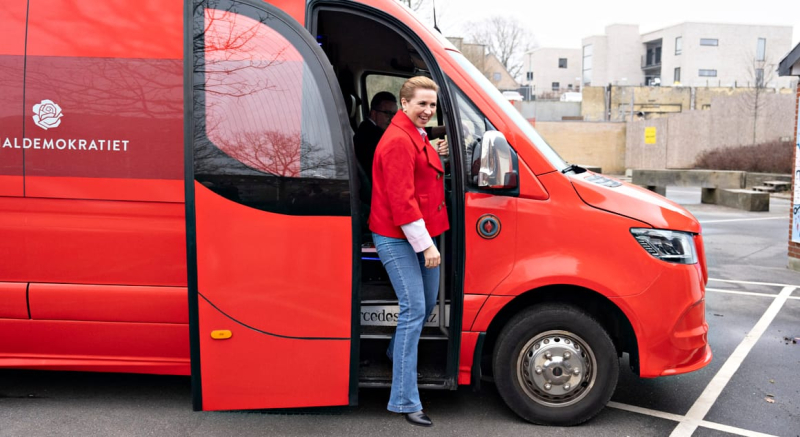

The Danish prime minister suffered a major slump in vote share, but will still be in pole position to lead the next government.
Denmark’s Prime Minister Mette Frederiksen emerged battered and bruised from a hard-fought national election, but with a viable path to retaining her grip on power in Copenhagen.
Despite suffering its worst result in more than a century, Frederiksen’s Social Democrats still won the most votes in Denmark’s election after a winter of discontent during which she battled with U.S. President Donald Trump over his ambition to seize Greenland, a self-ruling Danish territory.
The Social Democrats — at the head of the left-leaning “red bloc” of parties — now need to convince a veteran, pipe-smoking politician who sometimes brushes his teeth with soap, centrist chief Lars Løkke Rasmussen, to hand the party a third term in power after the post-election dealmaking.
“I’m obviously disappointed that we’ve lost ground. But I think it’s an acceptable result,” Frederiksen said as she arrived at a post-election event, according to Denmark’s TV2.
Frederiksen said in a speech that she intends to remain as prime minister but acknowledged that forming a new government will not be easy. She told reporters afterward she had already been in contact with “several” party leaders.
Frederiksen’s performance in Denmark — where the Social Democrats sagged but still held on — also reflects a broader pattern across Europe where the center-left is showing renewed fight. In recent votes from Castilla y León in Spain, to Marseille and Paris, to Slovenia and now Denmark, there are signs that standing up to Trump-style politics, or pushing back against Trump himself, can be a winning strategy.
Frederiksen called the snap election earlier this year after enjoying a surge in the polls following her clash with Trump, as Copenhagen fended off the U.S. president’s bid to take over the massive Arctic island.
The center-left boss, who promotes taxing the wealthy and maintains a tough stance on migration, won just 21.9 percent of the vote on Tuesday, with her red bloc falling short of the 90 seats needed to claim a majority, with all votes counted early Wednesday morning.
But Frederiksen’s faction, in winning 84 seats, edged out rivals from the right-leaning “blue bloc,” led by the Venstre and Liberal Alliance parties, which totaled 77 seats. Center-right Venstre, with 10.1 percent of the vote, suffered the worst result in its history.
Now, fraught coalition talks will begin, with control in Copenhagen likely hinging on which direction Rasmussen — the current foreign minister and leader of the Moderates party — will swing. His party has enough seats to hand power to Frederiksen, or to Venstre’s Troels Lund Poulsen atop the blue bloc.
Rasmussen called on both Poulsen and Frederiksen to “drop the trench warfare” after they spent much of the campaign attacking one another, despite serving in the coalition government together. “Come down and join us. You’re standing out by the corner flags; we’re in the middle. Come and play with us,” he said Tuesday night.
But Poulsen has ruled out forming a government with Frederiksen again, instead making a plea to Rasmussen to help form a conservative government.
After Denmark’s last parliamentary election in 2022, it took 42 days to form a government, when the results were far more clear-cut than what was produced by Tuesday’s vote.
Complicating the negotiations, the Red-Green Alliance — part of Frederiksen’s red bloc — has said it won’t join any government unless it’s strictly left-leaning, which could mean shutting out Rasmussen and the Moderates. “If she wants to use our mandates, she must put forward a red government,” said party leader Pelle Dragsted on Tuesday, after snagging 6.3 percent of the vote.
Pia Olsen Dyhr, leader of the Green Left in the red bloc, which finished in second place at 11.6 percent, judged that all options — red, blue or broad government — remain on the table, adding that coalition talks “will be tricky.”
The right-wing populist Danish People’s Party said it wants to make life as difficult as possible for Frederiksen and Rasmussen to form a government, with leader Morten Messerschmidt calling for the blue bloc to “stand together.”
Frederiksen first came to power in 2019, when she led the Social Democrats back into government and dethroned a Venstre-led administration, at that point led by Rasmussen. After winning reelection in 2022, she formed a broad, cross-party government with Venstre and Rasmussen’s breakaway centrist party, the Moderates.
The Danish prime minister is known for her tough line on immigration, while maintaining a more typically Social Democratic agenda on the economy and social welfare.
Frederiksen’s time in office has also been marked by controversy, chiefly the 2020 mink cull scandal, in which her government was heavily criticized for ordering the mass killing of mink without proper legal jurisdiction, as the animals were suspected of harboring the Covid-19 virus during the pandemic.