
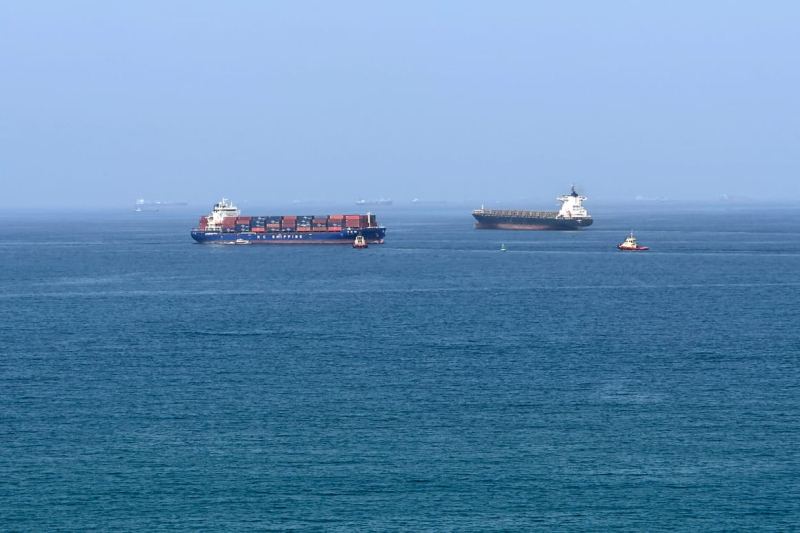

Tehran struck back with attacks on sites in Jordan, Kuwait and Oman, further threatening the fragile ceasefire.
The U.S. launched new strikes on Iran in the early hours on Sunday in retaliation for Tehran’s attack on a commercial vessel in the Strait of Hormuz, further jeopardizing an already fragile ceasefire agreement between the two countries.
The U.S. military’s Central Command said it hit roughly 140 military targets during the strikes, including Iranian missile and drone sites, naval capabilities and ammunition storage facilities. The strikes were in response to Iran attacking a ship in the strait on Saturday, the CENTCOM said.
In retaliation, Iran’s Islamic Revolution Guards Corps (IRGC) said its forces destroyed a command and control center and drone hangars in Jordan, targeted a U.S. radar site in Kuwait, attacked U.S. aircraft carrier support and refueling platforms in Oman and destroyed a jet maintenance center and command facility in Qatar, according to media reports.
The IRGC said early Sunday that it had closed the Hormuz waterway until further notice and warned of a severe response to U.S. aggression, according to state media. The IRGC warned that continued U.S. belligerence would be met with more severe responses, the semi-official Iranian news outlet Tasnim reported.
Nonetheless, U.S. President Donald Trump insisted later Sunday that the vital waterway was not shut. “It’s open. We bombed the hell out of them last night,” Trump said in an interview with NBC News program Meet the Press.
The strikes came just hours after Iran’s Foreign Minister Abbas Araghchi met with his Omani counterpart on Saturday to discuss “appropriate mechanisms for ensuring the safe passage of ships” in the Strait of Hormuz.
Iran’s lead negotiator, Mohammad Baqer Qalibaf, on Sunday said: “The era of one-sided deals is OVER. We told you: keep your word or pay the price. Reality is knocking,” in a post on the social media platform X.
On Saturday, Iran’s Ayatollah Mojtaba Khamenei swore that Iran would avenge the killing of his father, the former Supreme Leader Ali Khamenei.
About a fifth of the world’s traded oil and natural gas passed through the Strait of Hormuz before the U.S. and Israel launched their attacks on Iran in late February. The war has had major repercussions on global energy prices.
Iran’s Ayatollah Mojtaba Khamenei on Saturday swore that Iran would avenge the killing of his father, the former Supreme Leader Ali Khamenei, who was targeted early on in the U.S.-Israeli strikes against Iran.
“We pledge to avenge your pure blood and the blood of all the martyrs,” said Khamenei, who took his father’s place as the head of Iran’s leadership after a deadly Israeli airstrike. “This vengeance is what our nation is demanding, and this must definitely be done,” he added.
Trump, meanwhile, said the American military stood ready to “completely decimate and destroy all areas of Iran” in response to reports of threats to his life. Media reports have indicated that the U.S. president has received intelligence briefings from Israeli authorities that the Iranian regime was targeting him for assassination.