
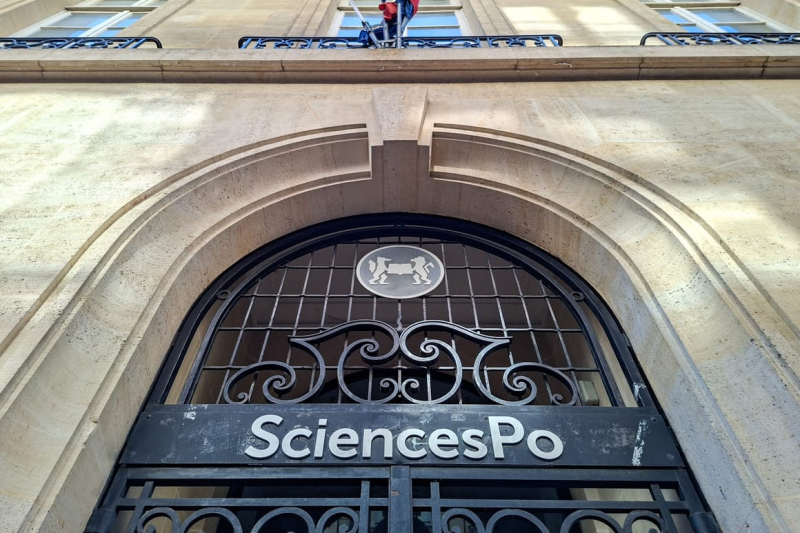

Students interested in Europe “do not spontaneously choose Sciences Po.” A Brussels campus would be a way to win them back, according to a new report.
BRUSSELS — French university Sciences Po is considering opening a campus in Brussels, arguing that the EU capital is “paradoxically” missing its own elite academic institution.
Brussels conspicuously lacks a significant presence of elite schools, according to an internal report obtained by POLITICO, and Sciences Po in particular is absent despite the dense network of alumni who staff the EU institutions, says the 18-page document.
One way to resolve that would be for Sciences Po to open a Brussels campus — called “Maison de l’Europe de Sciences Po, Paris-Bruxelles” — that could specialize in both EU-level research and training the next generation of Eurocrats, according to the memo.
The report draws a contrast between Brussels and Washington, D.C., which is home to elite schools like Georgetown University or Johns Hopkins University School of Advanced International Studies.
Unlike its American counterpart, the EU power center lacks such institutions “even though all the other protagonists in the debate are located there,” says the report, which contains other recommendations that would promote Sciences Po’s EU-level standing, like launching a “European thinker prize.”
The French school is making the proposal with an eye on the competition. Students interested in Europe “do not spontaneously choose Sciences Po” and instead turn to the College of Europe in Bruges or the London School of Economics. A Brussels campus would be a way to win them back.
The leadership of Brussels’ existing SciencePo faculty reacted coolly to the pitch.
“We have already seen projects of this type, and many have failed,” said Jean-Benoît Pilet, the dean of Université Libre de Bruxelles’ Faculty of Philosophy and Social Sciences, in comments to Belgian daily La Libre.
The report was written by the school’s 38-member committee, which includes Laurence Boone, a former French minister for Europe, and luminaries such as former Italian Prime Minister Enrico Letta, Nobel-prize-winning economist Philippe Aghion and the novelist Giuliano da Empoli. It was first reported on by French daily Les Echos.
In 2024, a pro-Palestinian protest at Sciences Po sparked accusations that a Jewish student linked to the UEJF was barred from entering, claims disputed by the university’s Palestine committee. French President Emmanuel Macron and then-Prime Minister Gabriel Attal swiftly condemned the alleged antisemitism, prompting Sciences Po academics and students to accuse the government of political overreach and importing American-style campus culture wars.