
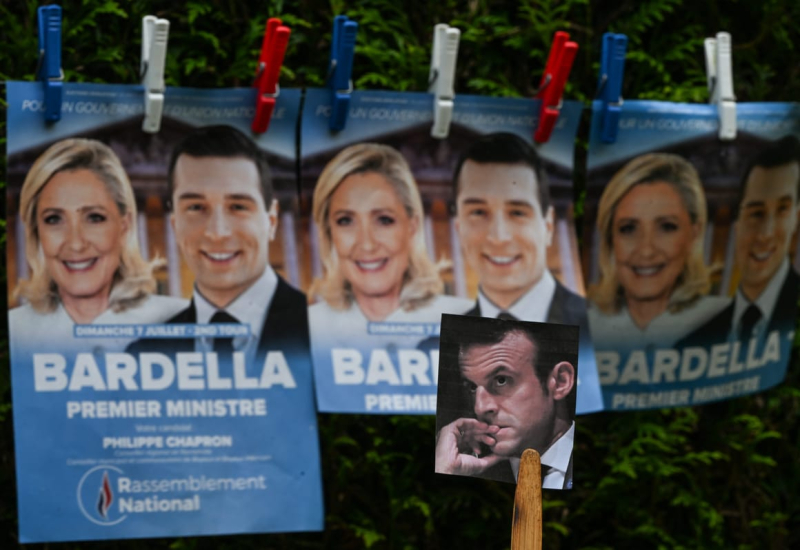

The far-right National Rally is already calling foul over controversial personnel moves.
PARIS — Emmanuel Macron is racing to put guard rails around a potential far-right president of France.
The French leader is accelerating key personnel appointments and placing loyalists in top positions to cement his influence and prevent the National Rally from executing its populist agenda, according to four French officials and two former officials.
Polls show the far-right party is the front-runner for next year’s presidential election, and Marine Le Pen and Jordan Bardella, its potential candidates, have signaled they would try to undo Macron’s economic reforms and pull back on French commitments to the EU and NATO.
“He [Macron] is worried about the dangers ahead and wants to shore up his legacy,” a former diplomat said, while the West faces instability triggered by Russian belligerence and American unpredictability.
Macron has already tapped an ally to become the country’s top auditor despite accusations of a conflict of interest. At the Ministry of Foreign Affairs, a sweeping reshuffle is underway that will go beyond the traditional summer envoy swaps in French embassies. More than 60 outposts are expecting to receive new ambassadors in the coming months, including in Washington, London, Berlin and Kyiv.
“Everything will be sewn up before the presidential election in May 2027,” a French ambassador told POLITICO.
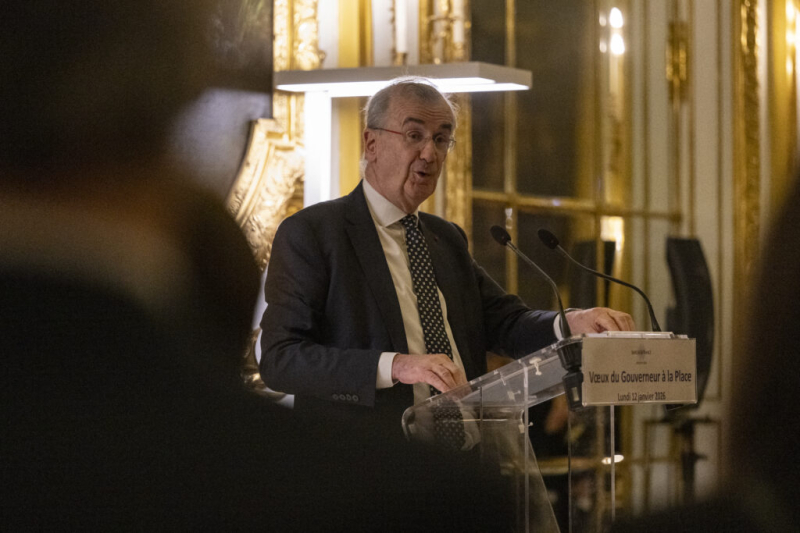
The early resignation of Bank of France Governor François Villeroy de Galhau last week also clears the way for Macron to name a new individual to that post, with a six-year term, before the next election.
And Macron’s decision to replace France’s top general over the summer was partly motivated by a desire to have a strong voice in that post to face a potential National Rally president, two military officials said. One of them, a top military officer, said the idea was to ensure that whoever was in the role had sufficient experience that they would be respected if they tried to push back on controversial National Rally proposals — including leaving NATO’s integrated command.
The personnel moves go well beyond those of a lame-duck leader attempting to seal his place in history, said the officials who spoke to POLITICO for this article, granted anonymity to speak candidly. They argue it amounts to a clear bid to insulate French institutions from possible National Rally-induced shocks.
It’s a tricky balancing act for Macron, though.
Appointing very close allies to some of these posts risks weakening their perceived independence and neutrality — whatever the original motive for putting them there.
And by placing allies in high posts, the French president may have other deadlines in mind beyond 2027, said the former diplomat. It has escaped no one that Macron, who cannot run for a third consecutive term, has already hinted that he may consider mounting a bid in the 2032 presidential election.
Locking down institutions
The National Rally may need to wait to choose a presidential candidate until Le Pen’s appeal of her embezzlement conviction and five-year election ban is decided in July, but it is already crying foul at what it calls Macron’s “illiberal” moves.
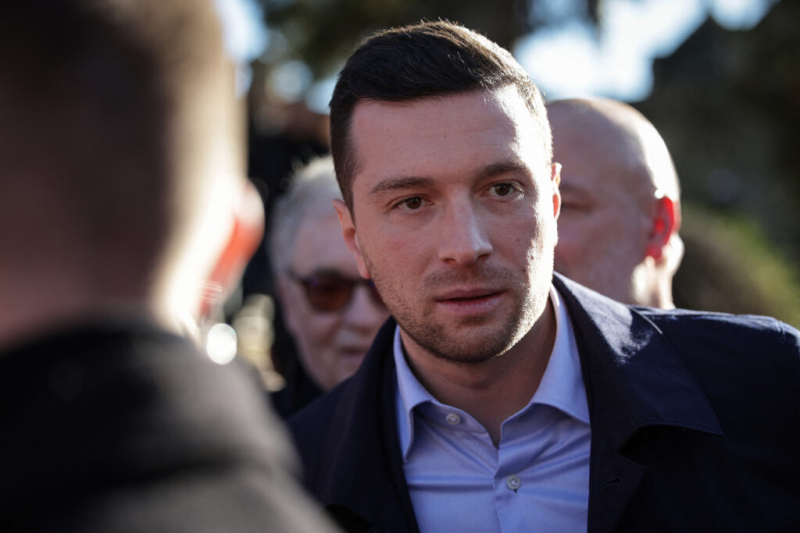
“President Macron is trying to lock down our institutions, hoping to keep control over them and extend his influence,” Bardella, the party’s “Plan B” presidential candidate, said Wednesday.
Asked at a European summit on Thursday about his efforts to safeguard institutions before he leaves office, Macron said it was an “important” question but declined to answer as it was not on the day’s agenda.
The French president has courted similar controversy with other personnel moves. He was criticized for injecting politics into the French bureaucracy last year by naming a political ally with limited legal training to lead France’s highest constitutional authority. And Macron’s pick to represent France on the European Commission in 2024, Stéphane Séjourné, also drew scrutiny given their close ties.
France boasts one of Europe’s most powerful presidencies, but that doesn’t mean its next leader will find it easy to remove or ignore Macron’s appointees.
The personnel moves will pose “a challenge for Marine Le Pen’s grand vision of real upheaval,” French constitutional expert Benjamin Morel said.
“The system is built with a number of safeguards. These might not secure Macron’s legacy, but they would limit her executive power even if it appears almost absolute in France.”
Not child’s play
More battleground appointments appear on the horizon.
Macron will need to choose a new head of the State Council — a key institution that acts as both government legal adviser and judge when it comes to litigation that pits citizens against the state — when the body’s current head reaches the mandatory retirement age of 68 in May.
“Administrative law is not child’s play, it deals with immigration disputes, public order, police … all topics that are very inflammable,” Morel said.
Within the EU, governments want to bring talks on the bloc’s next seven-year budget to a close before 2027, a European Parliament official told POLITICO.
And a debate is looming over whether to try to clinch the renewal of António Costa’s term as European Council president before it expires — shortly after the presidential election in France, the official said. “It’s going to become an issue, that’s for sure,” the official said. “You need unanimity, and [Hungary PM Viktor] Orbán, if he’s still there, and the Czechs are in the same group as Le Pen.”
Paul de Villepin contributed to this report.