
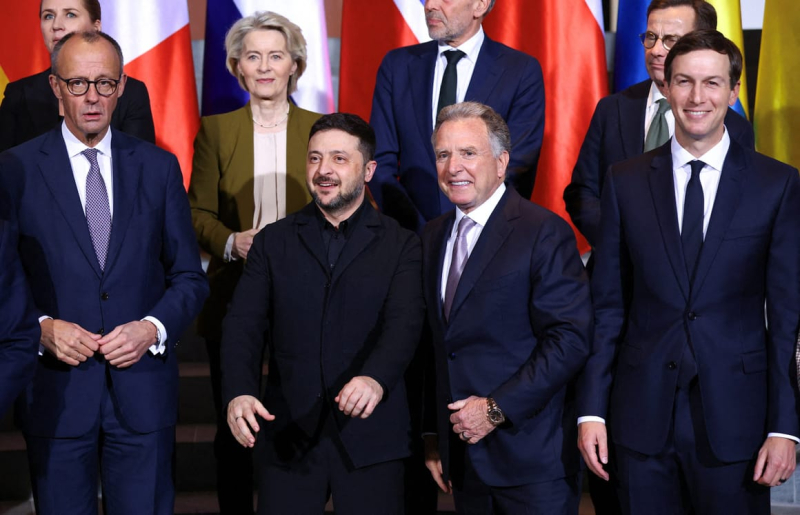

Washington proposes a NATO-style security pact but huge questions remain over contested territory and whether Russia will agree.
BERLIN — Western leaders welcomed major progress in talks on a potential peace deal on Monday after nearly four years of full-scale war in Ukraine, for the first time outlining how security guarantees could prevent Vladimir Putin from invading again.
Ukrainian President Volodymyr Zelenskyy gave an upbeat assessment of a dramatic new offer from American officials to provide a NATO-style assurance to protect Ukraine.
The proposals look “pretty good,” Zelenskyy said at the end of two days of talks with Donald Trump’s negotiators in Berlin. Trump himself said “we are closer now than we have been ever” to peace.
But the Ukraine president cautioned that the plans were only a “first draft,” with major questions remaining unresolved. For example, there was still no deal on what should happen to contested territory in the Donbas region of eastern Ukraine, much of which is occupied by Russian troops. And there’s no indication that Russian dictator Vladimir Putin will agree to any of it.
German Chancellor Friedrich Merz, who hosted the talks, welcomed what he called the “remarkable” legal and “material” security guarantees that American negotiators Steve Witkoff and Jared Kushner, Trump’s son-in-law, had proposed.
“For the first time since 2022, a ceasefire is conceivable,” Merz said at a press conference with Zelenskyy. “It is now entirely up to Russia whether a ceasefire can be achieved by Christmas.”
Critical step
The emergence of an outline security guarantee marks a potentially critical step forward in the negotiations. Ukraine has consistently said it cannot consider any solution to the question of what happens to territories occupied by Russian troops until it receives a security package that would deter Putin from invading again.
Putin has refused to countenance Ukraine joining NATO, and earlier this year Trump said American forces would not have a role in any peacekeeping mission.
However, recent days have seen a steady improvement in the mood among negotiators. “This is a truly far-reaching and substantial agreement, which we have not had before, namely that both Europe and the U.S. are jointly prepared — and President Zelenskyy has referred to Article 5 of the NATO Treaty — to give similar security guarantees to Ukraine,” Merz said.
Article 5 is the cornerstone of the alliance’s collective defense: It states that an attack on one member will be treated as an attack on all.
“In my view, this is a really big step forward. And, as I said, the American side has also committed itself politically and, in perspective, legally to do this,” Merz added.
Zelenskyy also, for the first time, suggested a solution could be in sight. “Before we take any steps on the battlefield, we need to see very clearly what security guarantees are in place,” he said. “It is important that the U.S. is considering Article-5-like guarantees. There is progress there.”
‘Significant progress’
In a subsequent joint statement the leaders of Denmark, Finland, France, the U.K., Italy, the Netherlands, Poland, Sweden and Norway joined Merz in welcoming the “significant progress” in the talks. The statement was also signed by European Commission President Ursula von der Leyen and António Costa, president of the European Council, who joined the national leaders for a dinner discussion with Zelenskyy in Berlin.
Their statement also laid out more detail on what the new peace plan might include, suggesting that “the U.S.” had “committed” alongside European leaders to guarantee the future security of Ukraine and to foster its economic recovery. This, the leaders’ statement said, would include commitments to support Ukraine’s army to maintain a “peacetime” strength of 800,000 to be able to “deter” and “defend.”
Peace would be enforced in part by a European-led “multinational force Ukraine” made up of contributions from willing nations and “supported by the U.S.” This force would secure Ukraine’s skies, support security at sea, and build up the Ukrainian armed forces, “including through operating in Ukraine.” The statement is not clear on exactly what role the U.S. would play in supporting the force.
Separately, the U.S. would be responsible for a mechanism to monitor the ceasefire and provide early warning of any future attack. There would also be a legally binding commitment to take measures to restore peace if Russia attacks again, potentially including “armed force, intelligence and logistical assistance.”
Further points in the proposal include joint efforts to reconstruct Ukraine and invest in its future prosperity, and continuing Ukraine’s pathway toward joining the EU.
On the matter of ceding territory, the European leaders said it would be for Zelenskyy to decide —if necessary by consulting the Ukrainian people. When it comes to land, Zelenskyy said, “frankly speaking, we still have different positions.”
The developments represent significant movement after weeks of stalemate. But there were suggestions from the American side that their offer may be time-limited, as the White House seeks to push the warring sides toward a peace deal by Christmas.
“The basis of that agreement is basically to have really, really strong guarantees, Article 5-like,” a senior U.S. official said. “Those guarantees will not be on the table forever. Those guarantees are on the table right now if there’s a conclusion that’s reached in a good way.”
Can Trump be trusted?
Privately, some European diplomats are reluctant to put their faith in a White House that has revealed new levels of hostility toward their continent in recent days. Others are not convinced that the security guarantee would work without giving Ukraine NATO membership.
“Where’s the credibility?” one European diplomat asked. “Article 5 without membership will just encourage Russia to try and test it.”
The latest U.S. National Security Strategy, which states that Europe is a decaying civilization under threat from migration, shocked EU officials when it was published earlier this month. Trump’s interview with POLITICO then compounded their concerns as he labeled European leaders “weak.”
“There’s a disinformation war here,” one EU diplomat said. “The terrible thing is it’s not only from the Russians and the Chinese or the Iranians. It’s also from the U.S.”
Meanwhile, in Brussels, EU countries remain locked in tense negotiations over how they can leverage more than €200 billion of frozen Russian sovereign assets to send a badly needed loan to Ukraine. If no new European cash is provided, Kyiv is likely to run out of money in the first half of next year.
Talks have stalled over Belgian concerns that it could face retaliation from Russia if it agrees to the “reparations loan” proposal, using funds held in a Brussels financial depository. In recent days, prospects of a deal — which EU leaders had wanted to sign at a summit this Thursday — have faded as other countries including Italy joined Belgium in raising concerns.
EU countries’ envoys continued examining new draft proposals aimed at reassuring Belgium late into Monday night.
Hans von der Burchard, Victor Jack, Nicholas Vinocur, Gregorio Sorgi and Eli Stokols contributed reporting.