
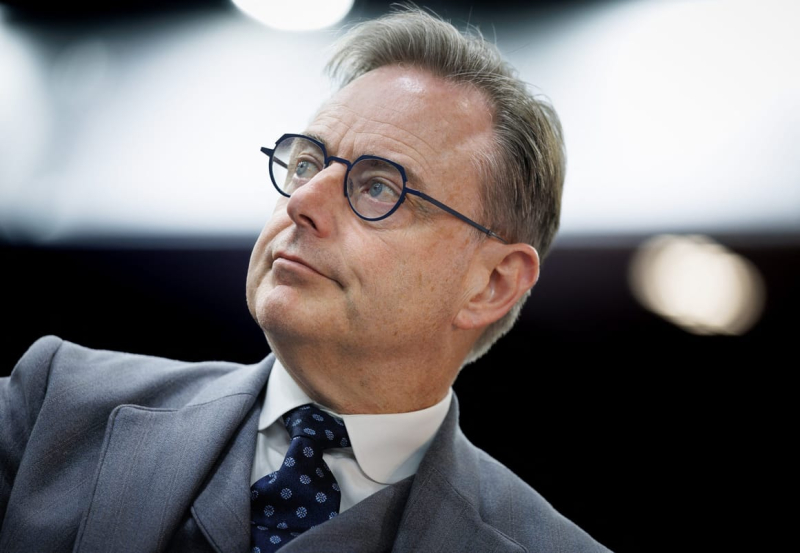

“Behind closed doors, European leaders tell me I’m right, but no one dares to say it out loud,” says Belgium’s leader as he suggests normalizing relations with the Kremlin.
Belgian Prime Minister Bart De Wever’s controversial suggestion that the EU should negotiate with Russia is convulsing his own coalition government.
Speaking to L’Echo, Belgium’s leader made the case for a deal to “normalize” relations with Moscow to regain access to cheap energy, as costs spiral thanks to another war in the Middle East.
Opposition politicians reacted furiously, while parties within De Wever’s government were also quick to distance themselves. Belgium’s ruling coalition required 236 days to negotiate a detailed reform agenda, and their ongoing disagreements have repeatedly turned into public quarrels.
The remarks cut against the EU’s broadly hard-line stance toward Moscow since its full-scale invasion of Ukraine began and threaten to fuel a sensitive debate in the bloc about sanctions and Russian energy.
De Wever’s comments also come after a nationwide poll last week revealed he enjoys widespread support, with the Flemish-nationalist leader’s popularity not only at a record high in Dutch-speaking Flanders, but also growing in French-speaking Wallonia. The strong polling may help explain the prime minister’s willingness to push a politically sensitive argument.
“The conflict must be ended in Europe’s interest. Without being naive about Putin. That’s a mistake we must never make again. We must rearm and remilitarize the border. And at the same time, we must normalize relations with Russia and regain access to cheap energy,” De Wever said in L’Echo, adding it was a matter of “common sense.”
“Behind closed doors, European leaders tell me I’m right, but no one dares to say it out loud,” De Wever was also quoted as saying.
You don’t speak for us
De Wever’s comments struck a nerve within his ruling coalition, which — apart from the prime minister’s Flemish-nationalist N-VA — includes the Flemish socialist Vooruit party, the French-speaking liberal Reformist Movement, and centrist parties from both sides of the language border, Les Engagés and CD&V.
“The prime minister can say whatever he wants in his own name, but he cannot speak on behalf of the government and claim that we now suddenly want to beg Putin for cheap energy,” Conner Rousseau, president of Vooruit, told the VTM channel on Monday.
In a long reaction Sunday, centrist Foreign Affairs Minister Maxime Prévot of Les Engagés called reducing Europe’s dependency on fossil fuels a “strategic necessity.”
“Should we engage in dialogue with Russia? Yes,” Prévot said — but added that “dialogue is not the same as normalization.”
“Today, Russia is refusing to allow European representatives at the negotiating table. It is sticking to its maximalist demands. As long as that remains the case, talking about normalization sends a signal of weakness that undermines the European unity we need now more than ever,” Prévot said.
On Monday, the centrist CD&V echoed Prévot’s words, saying “taking more gas from Putin again would only give Russia more money to continue its war in Ukraine.”
It’s all good, honest
De Wever’s Cabinet told POLITICO in a statement that the prime minister had made his comments in response to a question about a passage in his book Over Welvaart (About Prosperity), which has just been released in French, and concerned a hypothetical scenario after a peace deal.
The Cabinet added that Prévot’s Sunday message had been coordinated with the prime minster and was intended as a clarification.
Despite Belgium’s long tradition of coalition-building, the current government has struggled to bridge the various positions of its constituent parties — including, most recently, on pension reform and Belgium’s response to a request from Saudi Arabia for military aid.
Another issue erupted Monday evening after Interior Minister Bernard Quintin (MR) and Defense Minister Theo Francken (N-VA) announced that the Belgian armed forces would protect Jewish sites around the country, which blindsided Justice Minister Annelies Verlinden (CD&V).
Even after a Friday poll that showed De Wever is the most popular prime minister since 2008, when the category was first tracked, he said he wouldn’t stay on if divisions in his coalition paralyze his government.
“If this government becomes incapable of making decisions, I will not remain prime minister. Doing nothing until the end of the legislative term, contenting myself with going to the European Council to play the political heavyweight, does not interest me at all,” De Wever told the La Libre daily.
Camille Gijs contributed to this report.