

Contents
Sander Janca-Jensen talks Flatpay's future plans, swerving a Denmark IPO, and why Sweden outguns its neighbour.
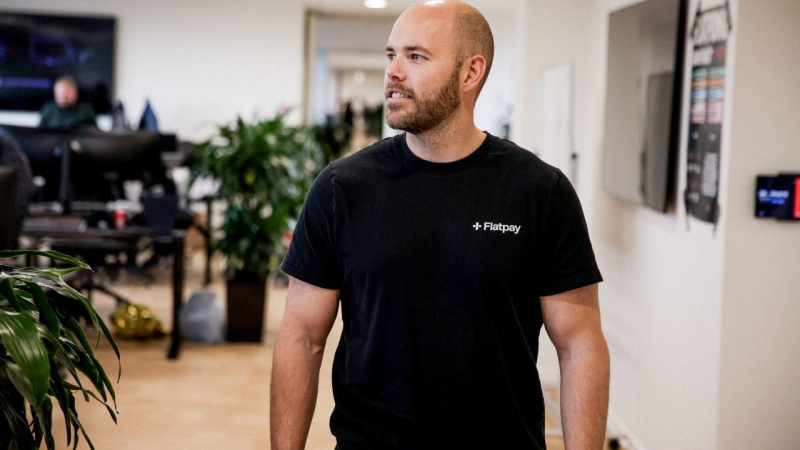
The CEO of Danish payment unicorn Flatpay is not a “yes” man. Sander Janca-Jensen says: “We say ‘no’ a lot. We pride ourselves on saying ‘no’ internally.”
Examples of Flatpay’s thumbs down mentality include saying “no” to new business opportunities, “no” to new distribution channels, “no” to potential new customers, and “no” to new tech. The 36-year-old father of two has also recently said “no” to eating candy (“one of the best decisions in my entire life”).
It’s not that Janca-Jensen is a naysayer; it’s that he doesn’t want Flatpay to spread itself too thin because, as he says, everything comes with an opportunity cost. “We don’t try to be something for everybody,” he points out, speaking over video.
Flatpay becomes a unicorn
Flatpay became Denmark’s latest unicorn last year (following the likes of Lunar, Pleo and Tradeshift) after landing $170 million in funding, reaching the $1bn valuation accolade in only three years. At the time Janca-Jensen pointed out that Flatpay was one of the few “non-AI” European startup unicorns.
Valuing Flatpay at $1.7bn, the funding round was led by AVP, the European and North American investor and Smash Capital, the backer of consumer internet and software firms, with other investors including Hedosophia, Seed Capital, and Dawn Capital.
Flatpay’s offering
Flatpay offers payment hardware and software for small and medium-sized merchants, such as retailers and restaurants, including payment terminals, all-in-one point of sale systems, and online payment solutions.
As it says on the tin, Flatpay’s USP is the flat transaction rate it charges merchants for the use of its kit. It primarily targets brick-and-mortar merchants, which make up around 95 per cent of revenues, with online merchants the rest.
Flatpay says it has around 70,000 customers (up tenfold from early 2024) and Janca-Jensen says Flatpay is adding between 10 and 15 per cent new customers each month.
It operates across its native Denmark, which accounts for around 25 per cent of revenues, as well as Finland, Germany, Italy, France, the UK, the recently-launched Netherlands, and is planning one unnamed new market for 2026.
Recruitment charge
It employs around 1,500 staff, or “Flatplayers”, and, says the CEO, is now on a manic recruitment drive, employing nearly 200 people a month.
Along with its flat fee, merchants are also enticed by its daily settlements, 24/7 customer service and “old school” in-person sales calls to sell its payment kit, he says.
He says: “Ninety-nine per cent of the cases we are going there in person, having a meeting with the person who owns or manages the store, and then we sign a contract at that meeting, we then come back with the same person and install the physical product.”
Moving into banking services and ambitious ARR targets
Janca-Jensen, who lives in Copenhagen, reveres the metric du jour, ARR (annual recurring revenue), posting on LinkedIn last year that Flatpay had topped €1m ARR in one day.
In 2025, its ARR quadrupled from €35m to €135m, while a €400m ARR is the ambitious goal for 2026.
How will Flatpay reach this target? He says: “The business is very stable. That means we don’t have to do much better than we are already doing. Of course, we will have to grow the sales force over the year.
“This year is about basically three things: making sure we get the Netherlands off well and we open our eighth market successfully. Then it’s about scaling in the market where we are. And we want to go out and build the product.”
Soon-to-launch “light” banking services for merchants, such as business accounts, cards and expense management, as well as software to help merchants build their brands, could provide fresh revenues.
Managerial style and relationship with co-founders
Flatpay has four co-founders: Janca-Jensen, Rasmus Hellmund Carlsen (head of marketing), Peter Lüth (CTO), and Rasmus Busk (head of international), all of whom have worked together in the past co-founding startups.
He says: “There have never been any founder-related issues. It also means we run the business together. I am obviously the CEO, but it doesn’t really matter too much that I have the title of CEO, because we try to be aligned on the direction of the company.”
Janca-Jensen says the co-founders are keen to push autonomy down through the startup. He says his strengths are on the commercial side of the business and scouting talent. Being self-critical, he says he can be a “pain in the arse” and can micro-manage too much.
Focused approach
Fundamental to Flatpay’s success has been eschewing a scattergun approach, launching multiple products, going after new markets willy-nilly, and being wooed by new tech. Janca-Jensen says: “We try to limit the number of things we do at the same time.”
Likewise, the startup does not like to get too far ahead of itself. “I don’t spend too much time on building the vision for the next five years,” he adds, pointing out that there are too many variables to think that far ahead.
Competitors and challenges
Flatpay has a big opportunity, playing in a multi-billion-dollar market in Europe alone, where many merchants are locked up with legacy players which dominate the market.
That said, it is going up against hyper-competitive businesses like Square, SumUp and Dojo.
One recent big deal in payments has been Mollie buying GoCardless. “I don’t know who got the better end of that deal,” he rues.
Other challenges facing Flatpay include a possible cyber-attack and, says the CEO, a Covid repeat, which would “really suck”.
Virtues of being a Danish startup
The advantages of being Denmark-headquartered are that the Danes are digitally savvy, with a strong pool of talent, he says.
However, looking ahead, which is not the Flatpay way, he says that “Denmark is potentially not the most sexy stock market to list in”.
Denmark has long been outshone by its neighbour, Sweden, AKA Silicon Valhalla, as a startup hub. Given the relative similarity in population sizes: Denmark, around six million, Sweden, around 10 million, Janca-Jensen says it’s not wrong to compare the two countries.
He says: “The biggest difference between Sweden and Denmark is that they have been very successful in the past on building phenomenal companies. And there is a lot of very smart people there.
“There is also a lot of capital from people who have been successful over the past that can be put back into the ecosystem.”
Outside work
Janca-Jensen, who lifts weights three times a week and looks ripped, is something of a fitness fanatic, clocking up 10,000 steps a day, wearing and sleeping with his Oura ring.
“If you don’t measure stuff, you can’t manage stuff,” he opines.
And why was cancelling candy such a good move? It helped with both weight loss and controlling his energy levels, he says.