

Contents
The startup targets industries where traditional payroll tools fail, using AI to automate onboarding, compliance, and workforce operations at scale
Valeria, a Barcelona-based payroll and workforce operations startup, has raised $2 million in a funding round led by Venture Friends, with participation from Fortino Capital and 10k Ventures.
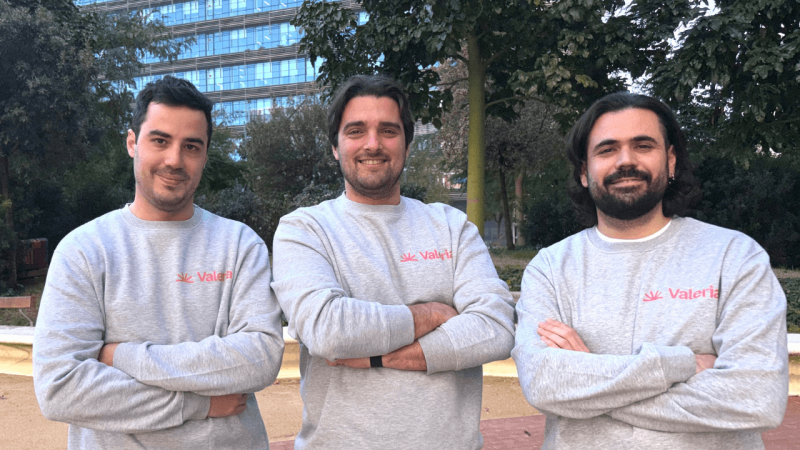
Founded by Pau Laporte, Carlos Saiz, and Sergio Morales Bonet, Valeria is pioneering a payroll and workforce management platform designed specifically for industries where high turnover and operational complexity are the norm, including hospitality, retail, logistics, and services.
These sectors face constant onboarding and offboarding, variable shifts, and complex compliance requirements — challenges legacy payroll tools were never designed to support.
I spoke with CEO and co-founder Pau Laporte to learn more.
From restaurant chaos to payroll rethink
The founding team brings firsthand experience from companies such as Uber, Getir, and Glovo, where they repeatedly encountered payroll systems that could not keep pace with frontline operational realities.
Before Valeria, Laporte spent almost 10 years in the tech industry, starting in restaurant tech and operations-heavy companies.
He recalls:
“Early in my career, I was leading operations in restaurants where there was very high turnover. I was managing around 150 riders at one point.
Payroll was extremely complicated — tips, variable hours, bonuses — and sending all that information to the accountant was a nightmare. I also needed to onboard employees during the weekend, but the accountant wasn’t working.”
The company was paying around €2,000 per month for a service that couldn’t respond to operational reality. Because of the delay, he couldn’t match supply and demand and was losing money. Later, he moved into larger operational roles in tech companies, at one stage managing operations involving up to 2,000 riders.
“You can imagine the scale of the problems,” he recounts.
“There were thousands of queries, labour compliance issues, no integrations, outdated processes, and recurring fines. The operations were chaotic.”
His last experience before Valeria was at restaurant software company Haddock, where he led the sales team. According to Laporte:
“It brought me back close to the restaurant industry, which is where the first version of Valeria came from.
Initially, Valeria started as an accounting solution for restaurants. But very quickly we realised payroll was the bigger opportunity.”
Why legacy payroll infrastructure is breaking
Europe’s labour market is undergoing a structural transformation. The era of stable, long-term employment is increasingly giving way to a workforce defined by frequent job changes, flexible contracts, variable schedules, and continuous onboarding — particularly in service-heavy industries.
Yet most payroll systems still operate as if headcount were static, built for monthly cycles, permanent contracts, and predictable workforces, leaving labour-intensive businesses stuck with outdated, unscalable infrastructure. Valeria was created to address this growing mismatch.
Payroll scales well. Almost every company outsources payroll, while accounting is often kept in-house. Even large enterprises rely on payroll providers. With AI, the team saw that it was finally possible to build something new in this space.
Building payroll for operational reality
Unlike traditional payroll providers, Valeria is purpose-built for high-rotation workforces.
The platform centralises payroll calculations, contract management, and compliance while integrating directly with operational and workforce systems, reducing manual processes and payroll errors. In less than a year since launch, Valeria is already used by more than 100 companies.
On top of payslip management, the platform resolves 94 per cent of client queries, including contract and employee-related requests. Valeria launched in January 2025 and today has over 100 customers. It has raised €1.5 million in equity and €200,000 in public funding, for a total of €1.7 million, and now has 18 employees, mostly engineers and operators coming from global tech companies.
“Valeria is tackling one of the most complex and overlooked problems in modern HR software, impacting millions of frontline workers across Europe that still use slow and traditional methods,” said Lily Joo from Venture Friends.
“High-turnover companies have fundamentally different needs, and the team has shown impressive traction by focusing on operational payroll complexity rather than generic HR workflows.”
Why payroll infrastructure is hard to modernise
For Valeria, the biggest challenge has been integration with government systems. “Social security and labour institutions don’t move at startup speed,” Laporte said.
“Most of them don’t have modern APIs, so you can’t simply plug in and exchange data smoothly.
Government integration is slow, inefficient, and requires a lot of engineering work. AI has helped us automate processes that would have been impossible a few years ago. That’s one of the reasons this company can exist now and couldn’t exist in the same way before.”
Another challenge is that many customers don’t have strong internal tech infrastructure. Traditional payroll software is difficult to implement and requires heavy training.
Because Valeria’s platform is AI-native, onboarding and daily use are more intuitive, reducing friction for clients. Valeria is building its payroll engine from the ground up with international expansion in mind.
According to Laporte, without AI, creating a pan-European payroll platform at speed would be almost impossible. Most existing providers operate in a single country because their architecture isn’t designed for cross-border scaling.
“By connecting AI directly to government systems and compliance logic, we can expand faster and build smoother integrations. That international capability is a core part of our strategy.”
Building an AI-native payroll engine
Valeria’s long-term goal is to create cross-border payroll infrastructure powered by AI. Valeria uses AI in two main ways.
The first is automated onboarding. Employers can send a WhatsApp message directly through our platform and onboard an employee into the social security system in seconds.
“Previously, that process required back-and-forth emails and could take one or two days, even with a good accountant,” explained Laporte.
The second is payroll execution.
“We’re building a system that automatically prepares and runs payroll by structuring all payroll data inside our platform. Once the information is standardised, it becomes much easier to expand internationally and support multiple countries.”
Looking ahead, the company is focused on scaling its infrastructure. “Our focus now is building the infrastructure that lets us operate across multiple countries while keeping the product simple,” Laporte said.
“Simplicity is critical for the type of companies we serve. They don’t want complexity — they want payroll that just works.”
With the new capital, Valeria plans to grow its team, deepen automation across the product, and expand into additional markets where labour-intensive businesses face similar challenges.