
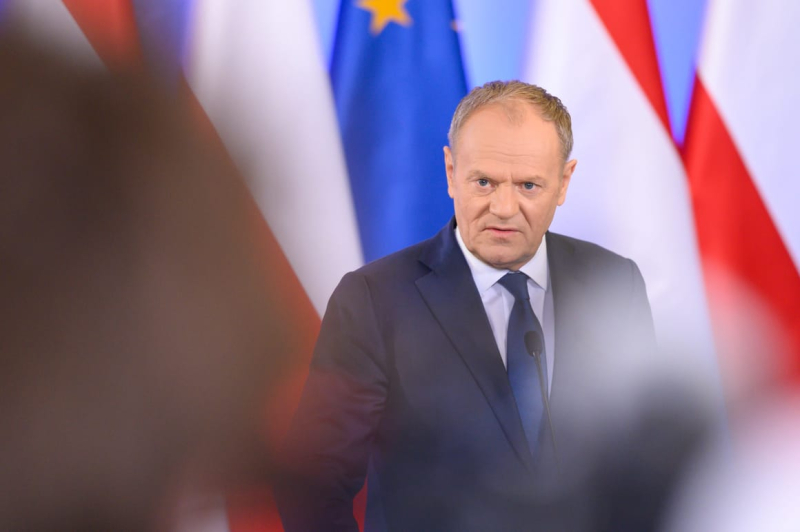

“We’ve had our suspicions about that for a long time,” Tusk said after Washington Post report on Hungarian foreign minister.
Polish Prime Minister Donald Tusk on Sunday said a media report alleging Hungary’s foreign minister regularly called his Russian counterpart to brief him during EU summits “shouldn’t come as a surprise to anyone.”
“We’ve had our suspicions about that for a long time,” Tusk posted on social media network X. “That’s one reason why I take the floor only when strictly necessary and say just as much as necessary.”
The Washington Post in a story published Saturday quoted an anonymous European security official as saying that Hungarian Foreign Minister Péter Szijjártó made regular phone calls during breaks at EU summits to provide his Russian counterpart, Sergei Lavrov, with “live reports on what’s been discussed” and possible solutions. POLITICO has not independently verified the story.
Szijjártó denied the claims in a post on X on Sunday, calling it “fake news.”
Szijjártó was responding to a X post by Poland’s Foreign Minister and Deputy Prime Minister Radosław Sikorski that referenced the Washington Post claim. “This would explain a lot, Peter. @FM_Szijjarto,” Sikorski wrote.
“Fake news as always,” Szijjártó responded to Sikorski. “You are telling lies in order to support Tisza Party to have a pro-war puppet government in Hungary. You will not have it!”
The Post’s story also said that Russia’s foreign intelligence service (SVR) had proposed staging an assassination attempt against Hungarian Prime Minister Viktor Orbán to boost plummeting public support ahead of next month’s parliamentary election in that country. It cited an “an internal report for the SVR obtained and authenticated by a European intelligence service and reviewed by The Washington Post.”
Orbán goes head to head in the polls next month with conservative opposition leader Péter Magyar, for the Tisza Party, who has emerged as a serious challenger.
Szijjártó extended his defense against the allegations in a post on Facebook.
Hungarians can “see clearly that this fake news, these lies that are part of Ukrainian propaganda, are not created for anything else, except to support the Tisza Party in the Hungarian election and to influence the outcome of the elections,” Szijjártó said on Facebook.
Magyar weighed into the controversy on the campaign trail. “The fact that the Hungarian foreign minister, a good friend of Sergei Lavrov, reports to the Russians almost every minute about every EU meeting is pure treason,” Magyar said in the Hungarian village of Nyúl, as reported by Hungarian outlet Telex. “This man has betrayed not only his country, but Europe.”