
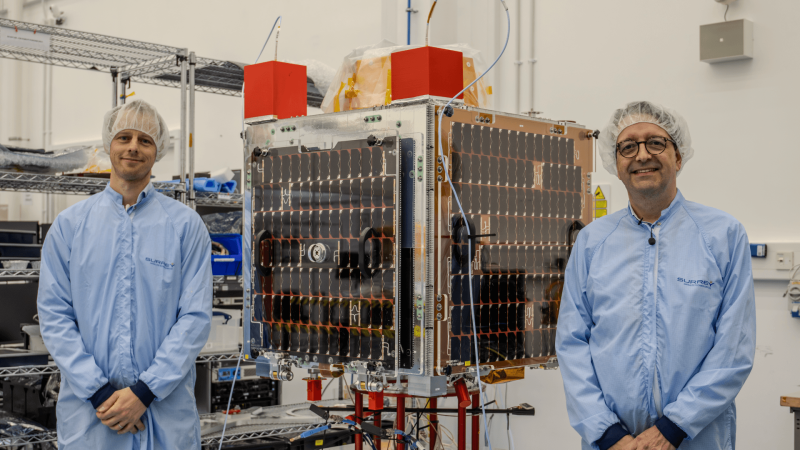

The funding will support the expansion of SatVu’s multi-satellite constellation, scaling its high-resolution thermal capabilities to deliver continuous day-and-night intelligence on operational activity and infrastructure.
SatVu, a UK-based thermal intelligence company that uses space-based data to analyse operational activity and infrastructure performance, has closed a £30 million funding round, bringing its total equity funding to £60 million. The round includes a strategic investment from the NATO Innovation Fund, alongside the British Business Bank, Space Frontiers Fund II (managed by SPARX Asset Management), and Presto Tech Horizons. Existing investors also participated, including Molten Ventures, Adara Ventures, Ridgeline Ventures, NOA, Lockheed Martin, Seraphim Space Fund, and Stellar Ventures.
As governments and allied institutions place increasing emphasis on resilience, readiness, and independent intelligence capabilities, demand is growing for reliable and persistent sources of operational insight. Traditional observation methods can limit visibility into activity across critical infrastructure and complex environments, particularly when continuous monitoring is required.
SatVu develops high-resolution thermal Earth observation technology designed to address these challenges. The company provides thermal intelligence data from space for government and defence customers, capturing activity both day and night at 3.5-metre resolution.
Its technology supports defence, security, and critical infrastructure monitoring, including activity around buildings and strategic assets, helping organisations assess operational changes and readiness where independent insight is essential.
Beyond defence applications, SatVu’s data also supports industrial and climate-related monitoring, including observations of blast furnaces, cement production, data centres, oil and gas operations, and energy generation such as solar farms.
Anthony Baker, co-founder and CEO of SatVu, said the company was established to provide governments with intelligence that is not available through other sources. He explained that high-resolution thermal imagery from space can reveal activity that is otherwise difficult to detect, including heat signatures linked to operations around buildings and critical infrastructure, helping governments assess activity, operational readiness, and changes relevant to defence and security decision-making.
To expand its capabilities, SatVu plans to launch two satellites in 2026, with three additional satellites already under contract as part of its transition toward a multi-satellite constellation. While a single satellite can observe any point on Earth, a constellation increases revisit frequency, enabling more continuous monitoring of activity and operational patterns over time.
The funding will support the deployment of this high-resolution thermal constellation and accelerate the company’s transition from a single-satellite demonstration to scalable commercial operations.